
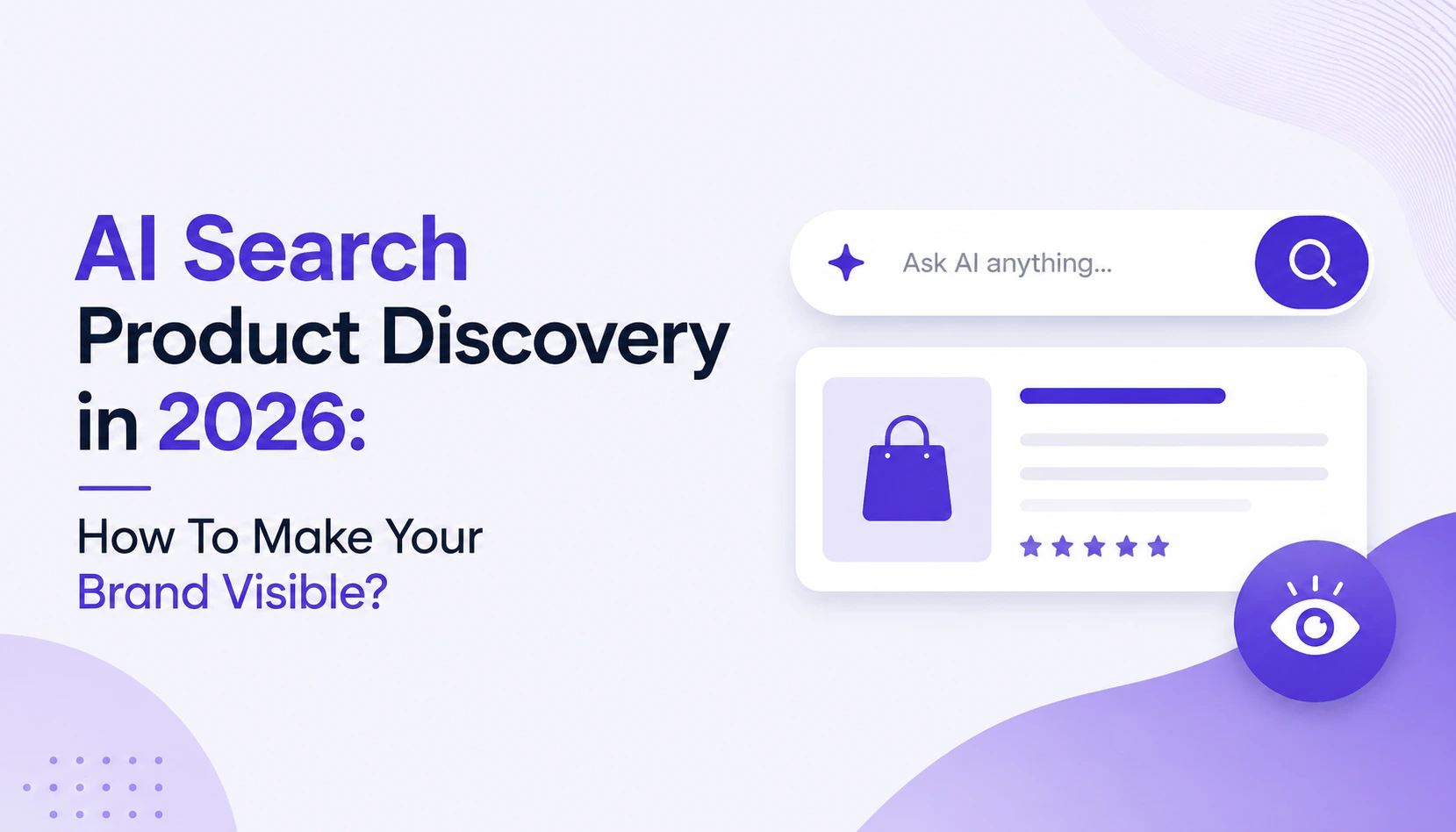
Why Do 50% of Shoppers Now Search With AI Instead of Google? What It Means For Your Brand
Earlier, shopping for let’s say a new pair of shoes meant searching the traditional way: typing a query into Google, scrolling through ten blue links, opening a few tabs for comparison, maybe checking Reddit threads for real opinions. Today, that search happens on AI Overviews and LLM platforms instead. This shift from traditional search to AI search visibility is slowly reshaping how brands get discovered.
If your brand isn’t appearing in AI search results, you’re not only losing a search ranking, but you are also losing a potential consumer even before they reach your website. This article discusses why AI search product discovery matters and what brands need to do to stay visible in this new kind of search.
Why Do 50% of Shoppers Now Start With AI Search Instead of Google?
As per the August 2025 survey on AI Discovery by McKinsey, nearly 50% of US-based consumers now use AI search for product discovery, and it’s not the twenty-somethings alone who are driving this. The consumers also include a majority of baby boomers and millennials, which suggests that this isn’t a passing trend tied to comfort with new technology. Understanding how consumers use AI to shop has quietly become one of the higher-stakes questions in marketing right now.
Let us walk you through what these insights suggest about AI search visibility, how AI Overviews and generative engine optimization for business is shaping the consumer behavior and what brands can do to make the most out of it.
Is AI Search Traffic Actually Converting Into Sales?
Survey answers are worth a healthy dose of skepticism. What people look for and what they purchase may not always be the same. So, it’s worth checking whether AI-driven discovery actually shows up in transaction data, and not just self-reported answers.
Adobe Analytics, which tracks over a trillion visits to US retail sites, recorded a 693.4% YoY jump in traffic referred from generative AI platforms during the 2025 holiday season. That’s not a rounding error or seasonal blip. It is traffic derived from a channel that barely existed two years ago, now arriving at a volume retailers have to actively plan around.
Interestingly, this AI-referred traffic converted noticeably better than traffic from traditional channels, and visitors were less likely to bounce right away. This makes sense because when someone reaches your site via an AI assistant, they usually already have their questions answered, already compared a few options, and have probably decided that your brand was worth a closer look. Simply put, they arrive pre-qualified in a way that someone skimming a search results page typically doesn’t.
Will AI Ever Make the Final Purchase Decision for Shoppers?
It is easy to assume that if “half of product discovery happens through AI” then checkout is possibly next on the list. However, this is not the case as of now, and that gap matters because it points to exactly where a business should be putting its energy.
Gartner’s January 2026 survey of US consumers found people are far more open to AI tools since they narrow down product choices, but not so much to AI making the actual purchase for them. Shoppers are happy to let an assistant handle the tedious part, reading reviews, comparing product specifications, and ruling things out. But they still want to be primary decision makers who clicks “buy,” on a site or app they already trust.
That’s genuinely good news for businesses willing to adapt. The goal was never to “win” inside a chat window you don’t control. The aim is to ensure that when an AI assistant is doing the research, your brand appears in the top two or three searches, so that your potential customer can find you.
Why Isn’t My Brand Showing Up in AI Search Results?
Most brands missing from AI answers can be due to the following reasons:
- Content is not structured properly to be cited by AI tools
- The main crux of the content is not highlighted upfront
- Mismatched search intent
- Content lacks topical depth
- Weak EEAT signals
Google has been fairly upfront that its AI-generated search features draw on the same core ranking and quality systems as traditional Search. A page still has to be indexed, crawlable, and well-structured before it stands any chance of being pulled into an AI-generated answer. There’s no separate shortcut. The brands showing up in AI answers today are probably the ones with solid technical SEO and genuinely useful content. AI search visibility is built on that foundation.
For instance, A page written to rank for a keyword and a page written to directly answer the question someone actually asked aren’t the same, even when they cover identical themes. The latter is what gets picked up and repeated. The former, even if it’s ranking well, often gets skipped because there’s no clean, extractable sentence for the AI to lift.
How Do You Check Your Brand’s AI Search Visibility?
Most of this is testable in a few minutes, no tools or subscriptions required.
- Test your brand visibility on AI Platforms: Open ChatGPT, Gemini, and Perplexity and type the exact queries someone shopping in your category would ask, not your brand name, the problem they’re actually trying to solve. Analyse the result and check if your brand appears and which competitors are appearing for that query.
- Audit your pages like AI system: Pull up your top three product or service pages. Do the first two sentences answer the question a visitor came with, or does the page lead with a slogan and make people dig for the information?
- Back every claim with AI-Citable data: If a page says, “trusted by thousands of customers,” is there a named author, a case study, a review, anything that an AI system could point to? Unsupported or vague claims can quietly skipped rather than cited.
- Add structured data to remove ambiguity: Structured FAQ, Product, and Article schema give AI systems explicit, machine-readable context about what a page is. It’s a small technical lift that removes a lot of ambiguity, and it’s one of the more overlooked levers in generative engine optimization for business.
- Track both citations and rankings: A page can rank on the first page and never get mentioned in an AI answer, and the reverse can happen too. These are genuinely separate metrics now and treating them as one hides the real problem.
What Should Businesses Do About This Now?
Half of consumers are already letting AI search shape what they buy, and the data backs this up. What hasn’t changed is that consumers still prefer to make the final call themselves. So, the real battle now is to make yourself discoverable for a product search first, then focus on conversion. If your brand isn’t structured for AI systems to understand and cite it, you’re not just losing traffic. You’re being left off the list before the customer even knows you were an option.
Key insight: AI search visibility, how consumers use AI to shop, generative engine optimization for business, AI Overviews visibility, AI product discovery statistics
Key Takeaways
Nearly 50% of consumers now use AI search as part of how they discover and evaluate products, a habit that spans every generation, not just younger shoppers.
This shows up in real traffic and real revenue, not just survey answers: AI-referred visits to retail sites have grown dramatically and convert better than traditional traffic.
Consumers still want to personally finish the purchase. AI is winning the discovery and shortlisting stage, not the final click.
If an AI assistant never surfaces your brand while comparing options, you lose the sale before the customer even reaches your website.
Want to know where your brand actually stands in AI search right now? Run your category’s top questions through ChatGPT, Gemini, and Perplexity this week, see who gets named, and start closing the gap from there. If you’d rather have a structured AI search visibility audit done for you, get in touch and we’ll map exactly where you’re being cited, where you’re missing, and what to fix first.
Frequently Asked Questions
1 Does “50% of product discovery” mean half of all sales now come through AI?
No. It means 50% of consumers now intentionally use AI-powered search as part of how they research and decide on purchases. Actual purchase completion through AI agents is a separate, much smaller behavior; consumers still generally prefer to finish the transaction on a site or app they trust.
2 Is the AI search trend limited to younger, tech-savvy shoppers?
No. Adoption of AI-powered search for purchase decisions spans every age group, including a majority of baby boomers and millennials. It’s closer to a universal shift in behavior than a generational one.
3 What's the single highest-impact first step to improve AI search visibility?
Test it yourself before changing anything. Use the exact phrases that customers use to ask the AI platforms about your specific category, see whether and how your brand comes up, and work backward from the specific gaps you find rather than guessing.
4 Does improving AI search visibility require abandoning traditional SEO?
No. It’s built on the same technical and content foundations as traditional SEO: crawlability, page quality, clear structure, rather than replacing them with something entirely new.
5 How is AI search visibility different from ranking on Google?
Ranking measures where a page lands on a results page. AI search visibility measures whether an AI system actually cites or names your brand inside a generated answer. A page can rank well and still never get mentioned, which is why tracking citations now matters as much as keyword ranking.
Ready to Build Your Next Digital Product?
Whether you need a high-performance website, mobile application, AI-powered solution, custom software, or digital marketing strategy, our team is here to help you transform your ideas into scalable digital experiences.