What Happened
On Wednesday, Oct 21, 2026, the PHP team released four patches for two critical vulnerabilities in the language. Agencies including the US NSA and CERT-EU warned that the flaws could give attackers direct access to server files or databases, with the potential to execute code remotely without logging in.
Security firms Calif and Wiz discovered the flaws using AI tools, working with the PHP team and OpenAI. The PHP Foundation had planned to disclose them later in the month, but details leaked on social media on Tuesday, forcing an early announcement.
Websites soon began going offline. In the Netherlands, the National Cyber Security Centre took its own site offline, followed by the Port of Rotterdam, the Overheid.nl government portal, the five largest political parties and several hospitals. Finland’s state IT provider shut down public government web services, while France’s Interior Ministry took prefecture sites offline. Germany, Belgium, Denmark and the Czech Republic also took sites down. Wikimedia withdrew some systems, and the Internet Archive briefly went offline.
The risk is not theoretical. Amazon’s security chief said its decoy systems detected an exploit attempt on Oct 17, four days before disclosure, followed by more attempts from multiple actors on Wednesday. Cloudflare’s CTO also reported early attacks emerging.
The scale of the issue is significant. W3Techs data cited by Reuters puts PHP at roughly 75% of websites whose programming language can be identified. Censys data shows that about 1.5 million of 2.6 million hosts were running a PHP version without a fix.
What We Learned From It
- Most owners do not know everywhere PHP runs. Sophos pointed out that the hard part is finding
and managing every instance, since PHP can sit under a CMS, a hosting platform or a third party tool
without being obvious. - Old versions are a dead end. The fix was reportedly issued only for the latest versions, and people
on PHP 8.1 or older were urged to upgrade rather than wait. - The gap between patch and attack is shrinking. Experts quoted by Reuters said AI tools can
reverse engineer a public fix with little effort, and one warned exploitation may now happen almost
instantly. - Your hosting setup decides your exposure. Reuters noted the risk is higher for small PHP sites on
shared hosting, where customers do not manage the server. Automattic said sites on its hosted
WordPress.com service and Tumblr were safe, but that statement covers its own platform, not
WordPress running on other hosting. - Patching is not the finish line. Because attempts were seen before disclosure, Sophos advised
checking for signs an attacker already got in. The UK NCSC also advised watching for updates to third
party products that bundle PHP
How We Help: Version Upgrade, Control and CMS Upgrades
PHP version upgrade and control
- A PHP version audit across production, staging, subdomains and microsites.
- Upgrade to a supported PHP version, with compatibility testing before the switch.
- Version control and change management: a documented PHP version per environment, staging first, a
rollback plan and a named owner for every change. - Ongoing tracking of PHP security advisories and end of life dates, so upgrades are planned instead of
forced by an emergency. - Coordination with your hosting provider on patched builds and timelines.
CMS upgrade solutions
- Core upgrades for WordPress, Drupal, Joomla and Magento.
- A plugin, theme and extension audit: what breaks on a newer PHP, what is abandoned and what to
replace. - Fixes for custom code that relies on deprecated functions.
- Staging, regression testing and rollback before anything goes live.
- SEO safe upgrades: URLs, redirects, meta data, structured data, speed and indexing checked after the
change. - A post patch security review: file changes, unknown admin users and suspicious requests
Key insight: PHP security flaw 2026, PHP vulnerability, PHP security update, PHP version upgrade, website security, PHP vulnerability fix, WordPress security, CMS security, website security action plan, PHP patch, website vulnerability protection
Key Takeaways
Two critical flaws in PHP were disclosed on Oct 21, 2026. Patches are out, but reports say they cover only the latest versions. Sites on PHP 8.1 or older are being told to upgrade.
Government, hospital and public sector sites in several European countries went offline as a precaution. Wikimedia took down some systems too.
AI found the flaws after they sat unnoticed for over a decade, and AI can also turn a public patch into an exploit fast. Amazon says it saw attack attempts four days before disclosure.
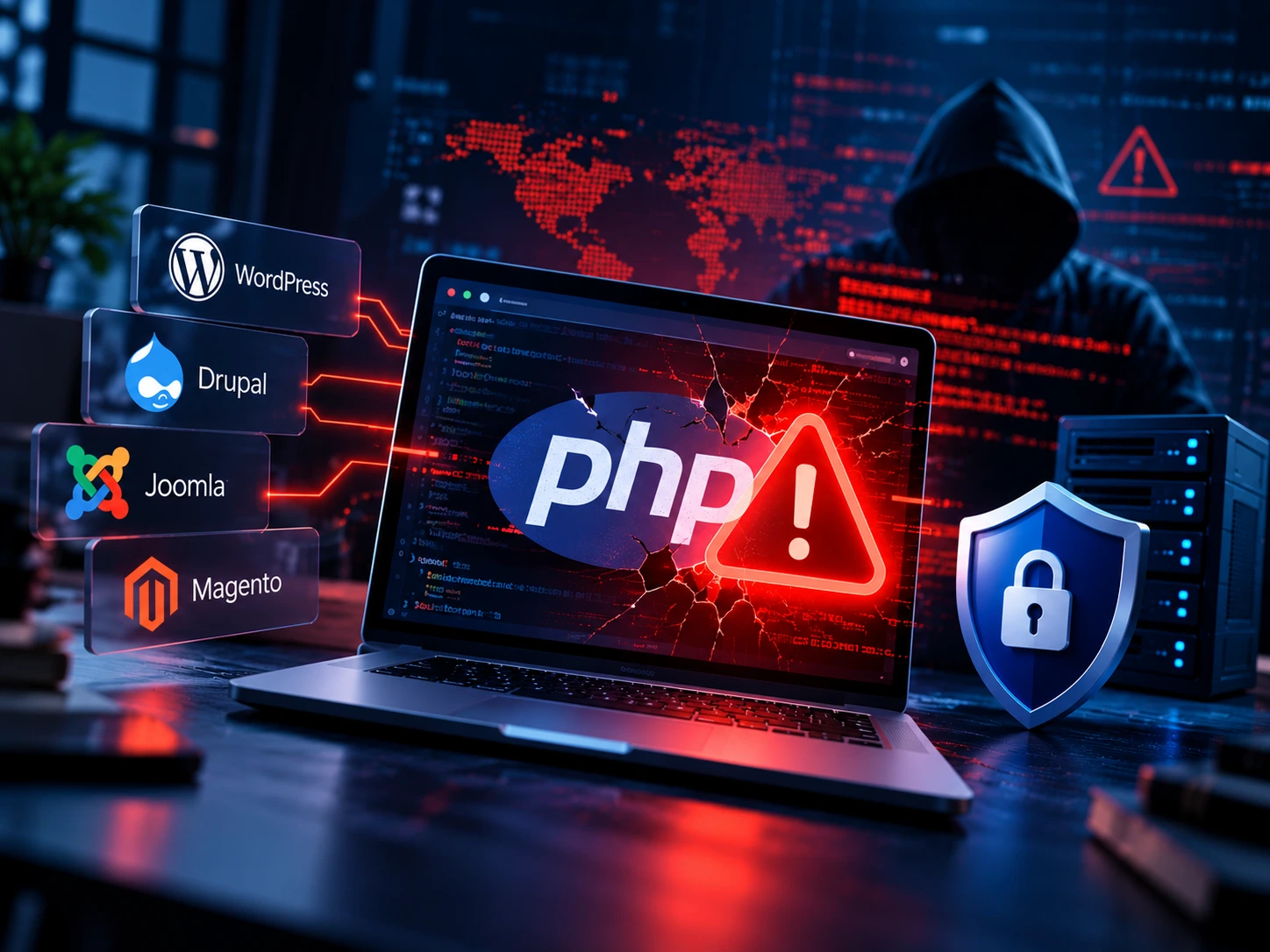
PHP runs under WordPress, Drupal, Joomla and Magento, so the fix is usually a hosting and CMS job, not a single click.
The response is straightforward: find every PHP install, patch or upgrade, test, and check for signs of compromise.
Action Plan
Today
- List every site, subdomain, staging copy and microsite you run, and note which use PHP. Most CMS sites do.
- Check the PHP version on each one. Your hosting panel shows it. If you use a phpinfo page, delete it afterward because it exposes server details.
- Ask your host in writing whether the patched PHP build is installed, and on what date.
- Apply the fix if one exists for your version. If you are on PHP 8.1 or older, start the upgrade to a supported version.
- If you cannot patch today, take the site offline or restrict access. Serve a maintenance page that returns a 503 status with a Retry-After header so search engines treat the outage as temporary. Also check whether your CDN or firewall provider has published mitigation rules.
This Week
- Review server and access logs from Oct 17 onward. Look for odd requests, new or changed files, unknown admin users and unexpected scheduled tasks.
- Update CMS core, plugins and themes, and test them on staging against the new PHP version.
- If anything looks suspicious, rotate database, admin, FTP and API credentials and restore from a clean backup.
- Check third party software that may bundle PHP, such as control panels, appliances and hosted tools.
This Month
- Write down a PHP policy: supported versions only, a named owner, staging first, a rollback plan.
- Subscribe to advisories from the PHP Foundation and your CMS, and track end of life dates.
- Restore a backup as a real test. An untested backup is a guess.
- Crawl the site after upgrades to confirm indexing, redirects and structured data are intact.
Need help with PHP or CMS upgrades? Email info@karrmanya.in.
Frequently Asked Questions
Is my website affected?
If it runs PHP, which covers most WordPress, Drupal, Joomla and Magento sites, it may be affected, depending on your PHP version and whether your host has applied the fix. Check the version and ask your host. Sites on hosted platforms such as WordPress.com were reported safe by Automattic.
Do I need to take my site offline?
Not by default. Agencies like the UK NCSC and the NSA suggested it where fixes cannot be applied in time. If you can patch today, patch. If you cannot, a short planned outage is safer than leaving the site exposed.
Will taking the site offline hurt my SEO?
A short outage served with a 503 status and a Retry-After header is treated as temporary by search engines. Avoid returning a 404, or a normal page that only says the site is under maintenance.
Will upgrading PHP break my site?
It can, mostly through old plugins, themes and custom code. That is why testing on staging before the change matters more than speed alone.
Is patching enough?
Not always. Exploit attempts were seen before disclosure, so check logs and files for signs of compromise after you update.
Ready to Build Your Next Digital Product?
Whether you need a high-performance website, mobile application, AI-powered solution, custom software, or digital marketing strategy, our team is here to help you turn ideas into scalable digital experiences.